Showing posts with label Salute Your Shorts. Show all posts

Monday, 11 October 2010

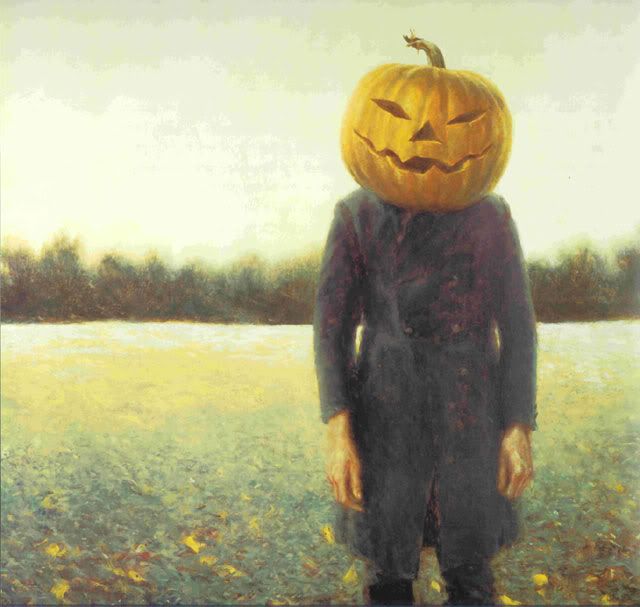
Salute Your Shorts! "Pumpkinhead" by Joyce Carol Oates

The story can be read in its entirety here: "Pumpkinhead" by Joyce Carol Oates
Joyce Carol Oates is one of those authors, where you go in expecting something sick and/or twisted to happen, even if everything is puppies and flowers until the last page. Part of the joy of reading her short stories is hunting for every possible clue as to what the final horror might be.

But this time, strangeness struck on page one, when our widow answers a knock to find a man with a pumpkin in place of his head. Lonely after the death of her husband, she invites him in for a drink, and we find out that he is not a stranger; she knows him as one knows a foreigner, cataloguing his attributes in terms of misprononciations and failures to assimilate. You have to believe that he can sense her disdain; as open as she is to us, these thoughts can not be far from her every action.

In that sense, it functions as a metaphor for hegemonic power - and the dangerous lengths that the powerless might go to obtain some semblance of control.

There is one lingering mystery though - a throwaway line almost: "She was a widow who had caused her husband to be burnt to ashes and was unrepentant, unpunished." The story offers no explanation for this, but I welcome the interpretation of others.

Friday, 8 October 2010

Salute Your Shorts! "The Harvest," by Amy Hempel


While Amy Hempel is considered a quintessential minimalist writer (she came out from the umbrella of Gordon Lish and Raymond Carver), this short story, probably her most famous, is more of a post-modern reflection on the nature of stories and story-telling. (Go ahead and read it here, then come back).


I can't remember how I came across her, but it seems a lot of people discover her thanks to Chuck Palahniuk, who wrote this loving essay in praise of Ms. Hempel. While I am not quite as inclined to gush as Mr. Palahniuk, I did enjoy the story. It's one of very few short stories that made me want to reread it immediately after the first run through.


"The year I began to say vahz instead of vase, a man I barely knew nearly accidentally killed me."


This is the first and last true statement in the story, as far as we can tell. It's a hell of an introductory sentence, conveying tons of descriptive detail about the narrator without stating it outright. What happens in the short story is that the narrator tells one story, full of embellishment, and then tells the second, 'real' story.


From the start, Hempel draws attention to the subterfuge that all storytellers use, not just writers:


"What happened to one of my legs required four hundred stitches, which, when I told it, became five hundred stitches, because nothing is ever quite as bad as it could be.


The five days they didn’t know if they could save my leg or not I stretched to ten."


I know that everything I've stated so far might give you the impression that it's quite a gimmicky little tale. But it isn't. Even though she's stated upfront that the story is not entirely true, the strength of detail draws you in anyway; we, the reader, are complicit in Hempel's deception. Every line is loaded with meaning and genuine depth of feeling. Even if the details are wrong, the emotions are real.
And that's what's important.

Wednesday, 29 September 2010

Salute Your Shorts: "A Rose For Emily"


Growing up in the suburban South, it was hard to see the romance or the adventure that many associate with turn of the century Southern life. But there was always a palpable darkness, the threat of snakes in tall blades of grass, even in fully developed housing developments. The news was filled with the criminality of the proudly uneducated, bootlegging crystal meth where they used to bootleg moonshine. Teenagers with loaded fists and loaded guns, ready to pounce on anything unfamiliar.

This is why, of the great American writers of the 1920's, Faulkner's stories tell of a place I actually recognize. I personally can't connect to Hemingway at all, a topic for another post, and Fitzgerald romanticized a life I dream about and aspire to, but I'm not sure actually exists. But there has always been something in Faulkner's novels and short stories that is reflected in the South even today.

I first read "A Rose For Emily" many years ago, probably in an American short story class I took at the University of Texas. This story didn't make the same impression on me that his novels did, such as Light in August, despite continuing the saga of the Sartoris clan.

The story was originally serialized in five parts in 1930. Having the luxury to read the whole thing in one sitting today could almost stop you from paying attention to the little details, the details that foreshadow the final horror. The first couple of parts set the mysterious Miss Emily up as a sort of Southern Miss Havisham, who famously decayed in her mansion along with her 50 year old wedding cake.

But, much like the people of the town, we can only guess at Miss Emily's inner life. We see into her house only as outside observers, never invited in or invited to participate. Nonetheless, by the end of the story, we have been given all the pieces to figure out exactly what happened, and very strong hints as to why.

Like any good horror story, the setting plays as important a role as any who walk and breathe, and Miss Emily's house plays much the same role as her black manservant, appointed liaisons with the outside world, who also function as shields. Faulkner conveys the passage of time by the decay of the house and the greying of Tobe's hair. And only when Miss Emily herself finally decays, do we find out her terrible secret.